Plastic Timber Planks and Poles in South Africa: Uses, Sizes, and Where to Buy

Treated pine has been the default structural and landscaping timber in South Africa for decades. It is widely available, familiar to builders and landscapers alike, and carries an upfront cost that makes it the obvious choice on most project budgets. However, the long-term economics tell a different story.
Treated pine retains a lot of water, which warps under load over time. The chemical treatment that protects it from rot and insects eventually leaches out and degrades, leaving the timber vulnerable. In high-humidity environments like KwaZulu-Natal, or in applications where the timber is in ground contact (retaining walls, fence posts, boardwalk supports), the lifespan of treated pine rarely exceeds 15 to 20 years and often falls well short of that.
Unique Timber Plastics’ plastic timber planks are made from 100% recycled HDPE, LDPE, and PP and are engineered to solve these problems precisely. They have the same dimensional formats as conventional timber, work with standard woodworking tools, and require no treatment, sealing, painting, or preservation at installation or thereafter. For contractors, landscapers, and builders who have calculated the true cost of timber maintenance and replacement over a project’s lifespan, the switch to plastic timber is not a compromise, but an upgrade.
What Are Plastic Timber Planks and Poles?
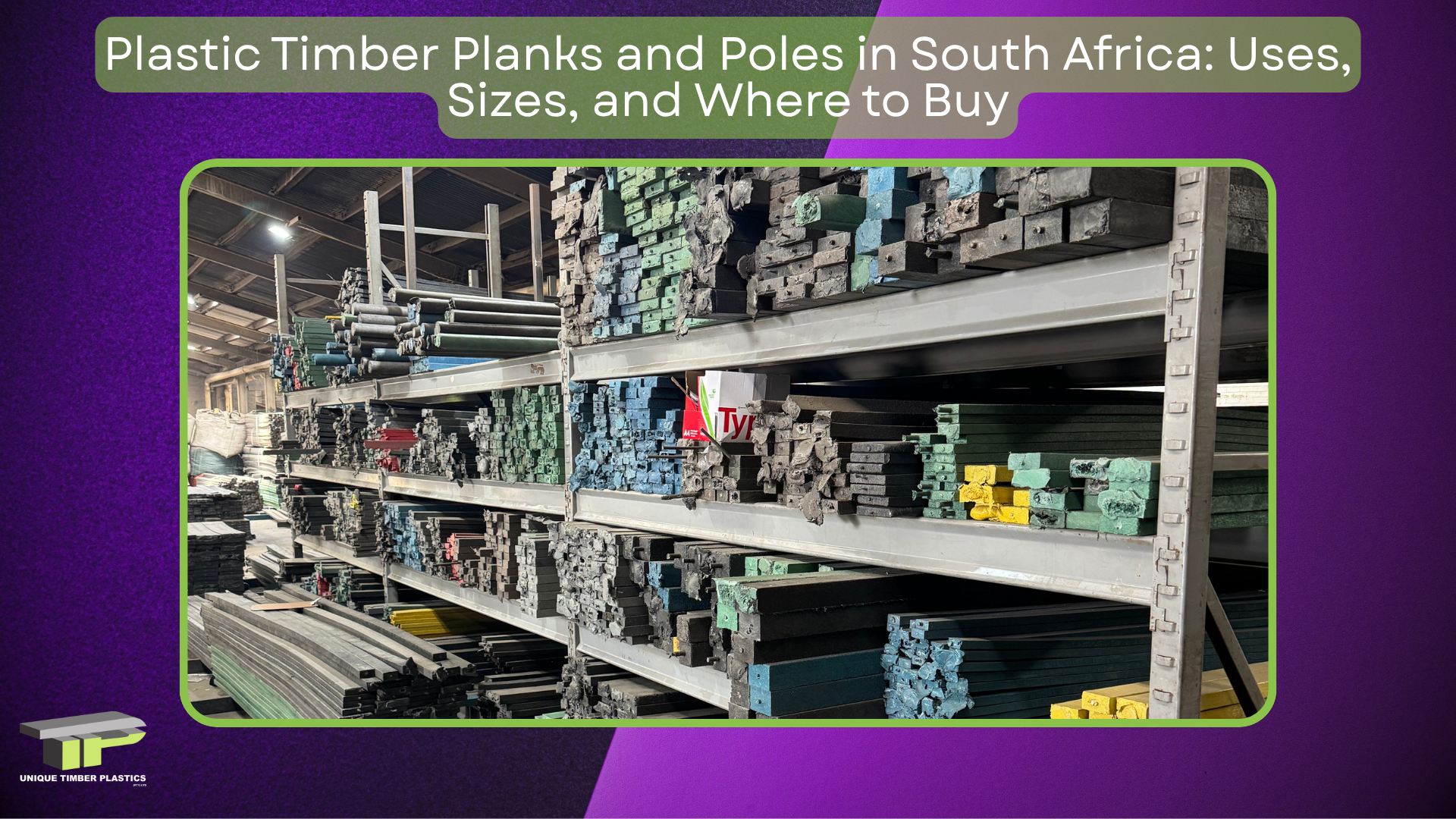
Plastic timber is manufactured by extruding recycled high-density polyethylene (HDPE), low-density polyethylene (LDPE), and polypropylene (PP), into solid profiles that replicate the dimensions of conventional timber perfectly. The raw material is post-consumer plastic waste (predominantly HDPE recovered from packaging), which is cleaned, sorted, melted, and extruded under controlled conditions into recycled plastic planks, poles, and other structural profiles.
The key word is solid. Unlike hollow plastic profiles used in some fencing or cladding applications, structural plastic timber is solid throughout its cross-section. This gives it great load-bearing capability, dimensional stability, and easy insertion of screws and bolts without requiring reinforced inserts.
The material is inert: it does not absorb water, rot, corrode, or provide nutrition for insects and fungi. It is UV-stabilised to resist surface degradation in direct sunlight, and it retains its structural properties across the entire temperature range experienced in South African weather conditions. It can be cut with standard woodworking saws, drilled with conventional bits, and shaped with routers. Fasteners should be stainless steel or a similar corrosion-resistant material.
Plastic poles and planks are available in natural timber-effect finishes, typically in brown, black, grey, and mixed-grain tones. Unlike painted finishes on timber, the colour in recycled plastic lumber runs through the full cross-section, with no surface layer to chip, peel, or require repainting.
Polywood vs Plywood: Understanding the Difference
A common source of confusion is the distinction between Polywood (or recycled plastic timber), plywood, composite decking boards, and wood-plastic composites (WPC). Polywood is manufactured from 100% recycled plastic (HDPE, LDPE, and PP) and contains no wood content whatsoever. Plywood, by contrast, is made from bonded layers of wood veneer. Composite decking and WPC boards sit somewhere between the two: they contain a blend of wood fibres and plastic, with adhesives and filler materials. These products are not 100% recycled plastic and behave differently; they can absorb moisture at the wood-fibre level, require surface sealing in some cases, and do not carry the same rot and insect resistance as a solid 100% recycled plastic product.
When comparing decking or structural materials, always confirm whether the product is genuinely 100% recycled plastic throughout its cross-section. Unique Timber Plastics’ planks and poles are solid 100% recycled plastic, not a composite, not a blend.
Common Sizes and Specifications
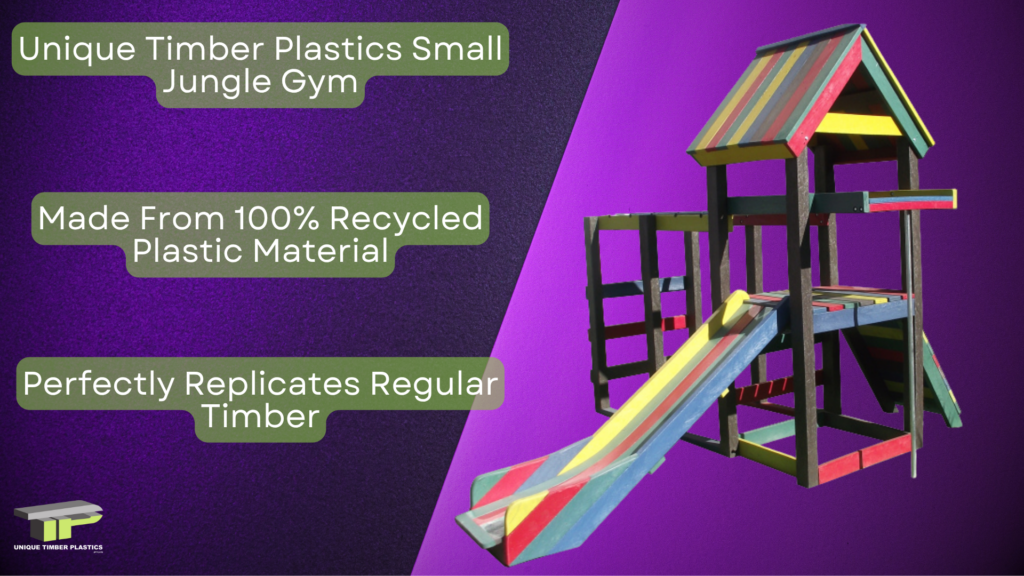
Plastic timber planks are produced in standard dimensions. The following table shows the available plank sizes from Unique Timber Plastics South Africa:
| Width (mm) | Thickness (mm) | Available Lengths (mm) |
|---|---|---|
| 50 | 24 | 2 400 |
| 38 | 38 | 1 800, 2 400 |
| 70 | 40 | 1 800, 2 400, 2 900 |
| 75 | 24 | 2 400 |
| 88 | 88 | 2 400 |
| 100 | 24 | 1 800, 2 400 |
| 100 | 38 | 1 800, 2 400, 2 900 |
| 100 | 50 | 1 800 |
| 100 | 70 | 3 500 |
| 140 | 24 | 1 800 |
| 140 | 38 | 3 500 |
| 140 | 100 | 2 400 |
| 145 | 30 | 2 900 |
| 220 | 38 | 1 800 |
For project-specific requirements or custom cuts, contact Unique Timber Plastics directly for a recommendation suited to your application.
Top Applications for Plastic Timber in South Africa
Fencing and Retaining Walls
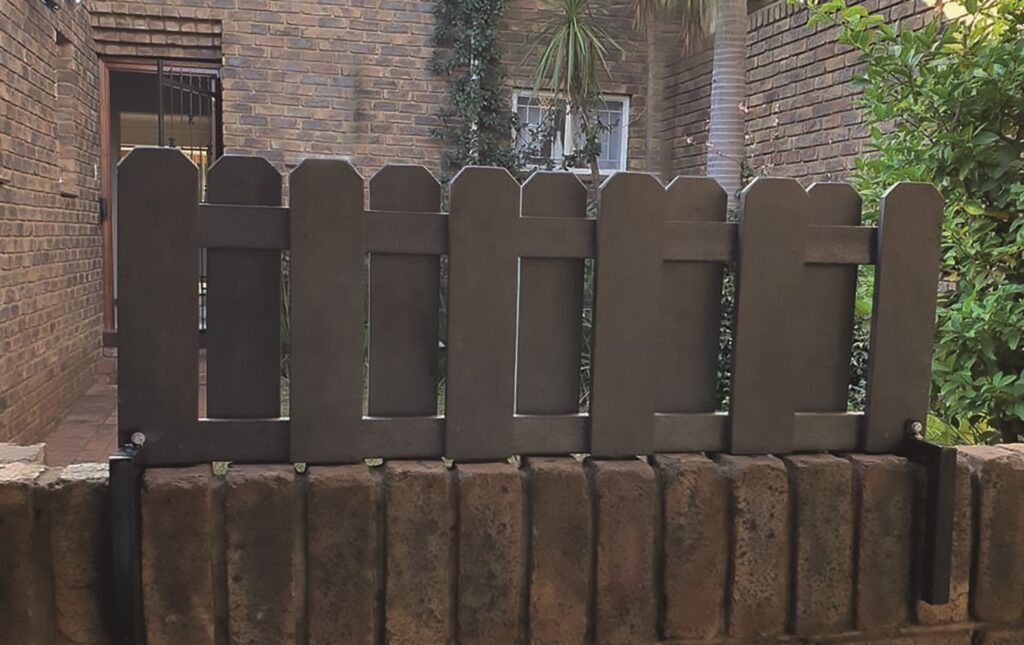
Ground-contact applications are where the performance gap between recycled plastic timber and treated pine is most pronounced. Fence posts and retaining wall components set into soil (even treated pine) are constantly in contact with moisture, soil microorganisms, and, in many areas, termites. Treated pine’s chemical protection is most effective when new but deteriorates over years of ground contact.
Plastic timber posts and planks cannot rot, cannot be attacked by termites, and do not absorb the moisture that accelerates timber degradation. A plastic timber retaining wall or fence installed today can last up to 60 years without replacement and, in most cases, requires minimal treatment. For property owners and developers who have experienced the cost of replacing failed timber retaining walls, this is a significant advantage.
Decking and Boardwalks
Decking is one of the highest-demand applications for plastic timber in South Africa, particularly for coastal properties, game lodges, and residential pool surrounds. The reasons align directly with the material’s properties of no splinters (important around barefoot areas such as pools), no warping (prevents uneven surfaces and trip hazards), no fading (leads to cosmetic maintenance costs), and no surface treatment requirements.
Boardwalks in nature reserves, wetland areas, and public parks benefit highly from the material’s resistance to the elevated moisture levels characteristic of those environments. Plastic decking boards do not become slippery in the same way that an algae-covered timber deck could, particularly where a grooved surface profile is specified.
Garden Edging and Landscaping
Plastic planks are widely used for raised garden beds, path edging, terrace steps, and other landscaping structures, as they hold their shape under lateral soil pressure extremely well, without the bowing or splitting seen in timber edging. It can also be easily cut and mitred to any angle desired on site. For landscapers, the elimination of the annual resealing or replacement cycle that timber garden edging often requires is a significant operational benefit.
Game Reserve and Lodge Infrastructure
Remote game reserve infrastructure presents challenges that make plastic timber an especially strong fit. Maintenance teams often visit structures infrequently, and replacement of failed timber requires transporting materials to remote locations. Environmental conditions in many reserves (high humidity, termite pressure, and seasonal flooding) are particularly damaging to conventional timber.
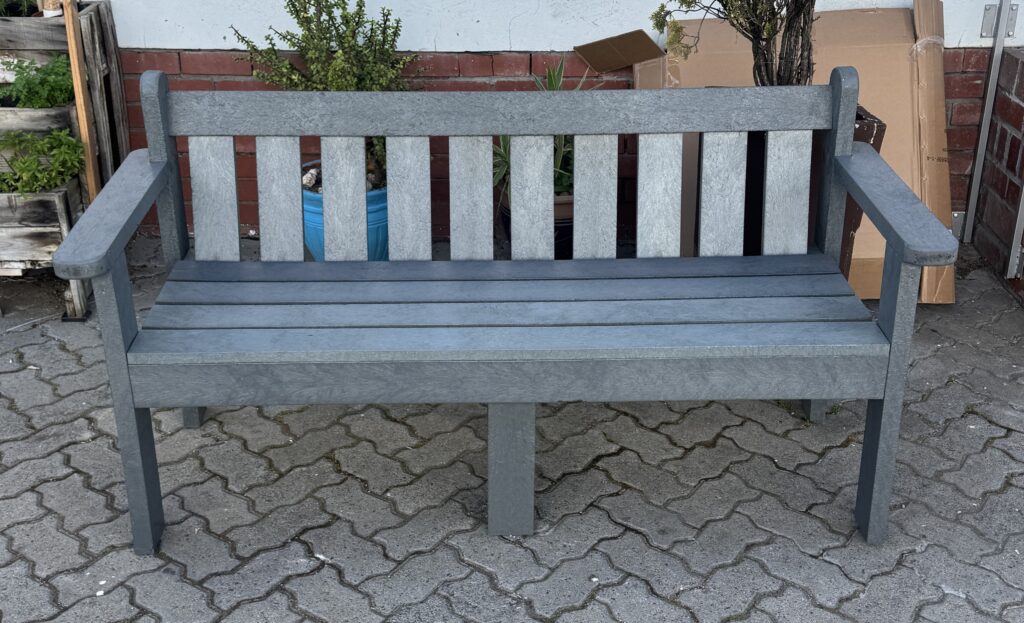
Plastic timber boardwalks, viewing platforms, fencing, signage posts, and outdoor furniture components in game reserves require no ongoing treatment and will hardly ever need replacement within its operational lifespan. The material’s resistance to insect damage is particularly relevant in areas where termite populations are substantial.
Structural Support and Framing
For non-load-bearing structural applications (pergola frames, carport supports, fence frameworks, gate structures), plastic timber poles and beams perform comparably well to hardwood and drastically outperform treated pine in longevity terms. The material does not compress or deform under sustained load, unlike low-density timber, which normally does so over time.
Unique Timber Plastics also manufactures plastic timber poles for structural applications. Speak to our team directly for sizing and specification guidance suited to your project.
It is important to note that plastic timber has different structural characteristics from hardwood, as it has lower stiffness (modulus of elasticity) and a higher threshold for thermal expansion. Structural applications should account for these properties in design, and large-span load-bearing structures should be engineered accordingly.
Recycled Plastic vs Treated Timber: A Side-by-Side Comparison
| Factor | Recycled Plastic Timber | Treated Pine |
|---|---|---|
| Lifespan | 50–60+ years | 15–25 years (ground contact), 25–40 years (above-ground) |
| Maintenance required | None | Sealing/treating every 2–5 years |
| Rot resistance | Complete – will not rot | Dependent on treatment integrity |
| Insect resistance | Complete – termite and borer proof | Partial treatment degrades over time |
| Moisture absorption | None | Yes – causes warping, swelling, splitting |
| UV resistance | UV-stabilised – resists fading | Fades and greys without treatment |
| Repainting/refinishing | Never required | Required every 3–7 years |
| Environmental impact | Diverts plastic waste from landfill | Requires ongoing harvesting and chemical treatment |
| Workability | Cuts and drills with standard tools | Cuts and drills with standard tools |
| Upfront cost | Higher | Lower |
| 20-year total cost | Lower (no maintenance, no replacement) | Higher (maintenance + likely one replacement) |
The upfront cost difference is the most common objection raised by buyers who are considering plastic timber over treated pine. On a per-metre basis, plastic timber is more expensive. However, on a total-cost-over-time basis, accounting for maintenance, treatment, and replacement cycles, plastic timber is typically less expensive over a 20-year period, and substantially less expensive over 30 years or more.
Frequently Asked Questions
Can plastic timber planks be used in the same way as wood?
For most common outdoor construction and landscaping applications, yes. Plastic timber can be cut, drilled, screwed, and shaped with standard woodworking tools. It does not split when screwed, does not require pre-drilling in the same way as hardwood, and has no grain direction that affects the way you’d want to use it. Structural engineering applications may require specialist design input to account for the material’s specific stiffness and thermal expansion characteristics.
Do plastic timber planks warp or bend over time?
Plastic timber does not warp in the way that wood does in response to moisture changes. It expands and contracts slightly in response to temperature changes (thermal expansion), more than wood does. For longer spans, this should be accounted for with appropriate expansion gaps being set in place, as you would with composite decking. Under sustained load, some plastic profiles may exhibit minor creep (slow deformation), this is more relevant in spanning applications and can be easily mitigated through appropriate structural design.
Are plastic timber poles strong enough for fence posts?
Yes. For standard residential and light commercial fencing, plastic poles set in concrete footings perform extremely well and will significantly outlast treated pine posts. For high-security or high-load fencing applications, consult with the manufacturer on appropriate pole sizing and installation specifications, as these initial design steps are crucial to ensure proper functionality of plastic timber.
Can you paint or stain plastic timber?
Painting is not required (and generally not recommended), as the colour runs through the full cross-section of the material. If colour matching is required for a specific project, manufacturers can be consulted regarding available colour options. Some specialist plastic paints adhere to HDPE, LDPE, and PP surfaces, but the adhesion is not equivalent to painting a porous timber surface.
Why should Unique Timber Plastics be my first choice for plastic timber?
When it comes to recycled plastic timber, Unique Timber Plastics (UTP) should be your first choice. As South Africa’s leading manufacturer of recycled plastic furniture and planks, UTP sets itself apart through an uncompromising commitment to quality. Carefully sorting, cleaning, and purifying every batch of raw material before processing, removing metals and impurities to ensure 100% recycled plastic of the highest grade. Whether it’s simple backyard furniture or large-scale structures, our wide selection of recycled plastic furniture options will cover all your needs in one convenient place.
Does the installation method matter with plastic timber?
Yes, and this point is important. Plastic timber planks and poles perform exceptionally well when installed correctly for the intended application. Incorrect installation, such as inadequate footing depth for fence posts, insufficient joist spacing for decking, or unsupported long spans, can lead to performance problems that are not a reflection of the material itself. For straightforward applications such as garden edging or raised beds, most competent DIY builders will manage without difficulty. For fencing, retaining walls, decking, or any structural application, follow the manufacturer’s installation guidelines or consult a qualified contractor. Unique Timber Plastics can provide specification guidance for your specific project. Contact us before you build, not after.
The Practical Choice for Builders and Landscapers
For contractors and landscapers who have time and time again replaced rotted retaining walls, re-oiled decking that looks worse every year, or watched termites clean through a fence line, plastic timber planks produced by South African manufacturers are a direct solution. The material works with existing skills and tools, installs in the same way as timber, and then (unlike timber) simply continues to perform without further intervention.
For anyone specifying materials on a project where long-term performance matters, Unique Timber Plastics manufactures a full range of recycled plastic planks, poles, and structural profiles in Johannesburg and Cape Town. They supply contractors, landscapers, game reserves, estates, and developers nationally, and assist with sizing and specification for specific project requirements with a smile. Choose a proudly South African business, determined to improve our environment for your plastic timber needs.
Johannesburg branch: 011 626 2487/078 152 3605 | enquiries@timberplastics.co.za
Cape Town branch: 079 525 0361 | capetownsales@timberplastics.co.za