Plastic Playground Equipment in South Africa: Safe, Durable & Maintenance-Free
A child enjoying their time on a school playground shouldn’t need to worry about splinters from cracked timber decking, sharp edges from rusted metal handrails, or surfaces too hot to touch after a morning in the sun. These are not hypothetical concerns; they are well-documented reasons for playground injuries at South African schools, parks, and residential estates.
The materials used in traditional playground construction (treated timber and painted mild steel) were never ideally suited to South African climate conditions. Both degrade in ways that create genuine safety hazards, and both require ongoing maintenance and replacement to remain serviceable. In practice, that maintenance is often deferred, which means the hazards only compound over time.
Unique Timber Plastics is the best choice for plastic playground equipment in South Africa, produced from 100% recycled high-density polyethylene(HDPE), low-density polyethylene(LDPE), and polypropylene(PP) addresses these problems at the material level. The equipment does not splinter, rust, require repainting, or fail in a way that creates sharp or unstable surfaces. For anyone responsible for a children’s play environment (a school principal, an estate manager, a municipality parks department) understanding why the material matters is the starting point towards creating a safe and welcoming environment for children.
Why Traditional Playground Equipment Fails in South Africa
Buyers often underestimate the degradation span that the South African climate has on standard timber and metal.
Treated timber begins to degrade as soon as it is installed. Sun exposure bleaches and dries the equipment’s surface, causing cracking and checking. Rain and humidity cycles cause the timber to repeatedly swell and contract, opening joints, lifting surfaces, and loosening fasteners. The chemical preservative treatment that protects the timber from rot and insects leaches out over time, resulting in extremely rough surfaces, particularly in high-rainfall areas and where equipment comes into contact with the ground. Within five to ten years under demanding conditions, treated timber playground equipment is prone to splinters and cuts from loose boards, protruding sharp edges from cracks, and overall structural instability.
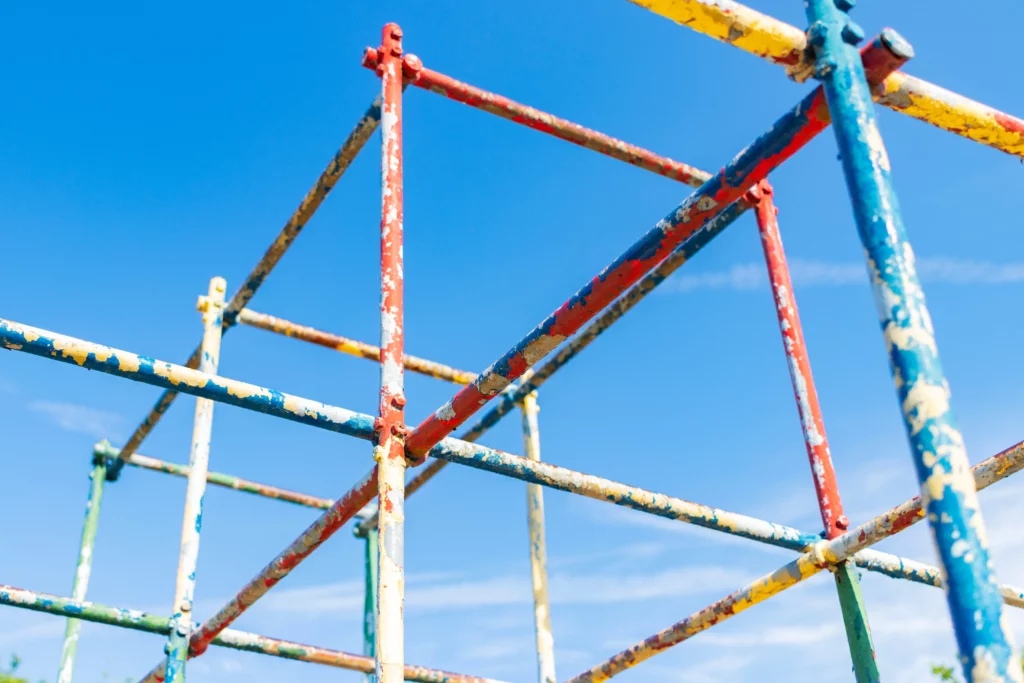
Mild steel and painted metal equipment face their own degradation pathways. Scratched and chipped paint exposes the base metal to moisture and salt air, initiating rust that spreads beneath the paint and creates air bubbles throughout the entire coat, eventually leading to peeling. Rusted metal edges and fastener heads are a direct cut and laceration hazard for children whose focus is not on staying safe, but on enjoying their time on the equipment. In direct sun, metal surfaces reach temperatures that can cause serious burns on exposed skin, something a young child might not think about before touching or sitting on the equipment.
Both materials require regular inspection, maintenance, and replacement to remain safe for children. In budget-constrained environments, this maintenance cycle is often put off, and the gap between required and actual maintenance is where safety incidents occur.
How Recycled Plastic Playground Equipment Ensures Safety
Recycled plastic jungle gyms manufactured in South Africa by Unique Timber Plastics are made with high-density polyethylene (HDPE), low-density polyethylene, and polypropylene (PP) which are derived from post-consumer plastic waste. The material is extremely solid throughout (not hollow or thin walled), and its structural properties remain stable across South African temperature and humidity ranges.
The material case for recycled plastic materials in playground applications rests on these three important intersecting factors:
On safety: the material does not splinter, rust, or develop sharp edges or unstable surfaces, as timber and metal often do. These are not conditional statements; they are properties inherent to the material that do not require ongoing maintenance to preserve.
On durability: recycled plastic playground equipment has an expected structural lifespan of 60 years or more. In practice, this means that equipment installed at a school or park today will outlast multiple cycles of timber or metal replacement, remaining serviceable without structural intervention.
On the cost of ownership: the higher upfront cost of recycled-plastic equipment is offset within a few years by the elimination of maintenance costs, including painting, sealing, timber treatment, rust remediation, and component replacement. Over a ten-year period, the total cost of implementing recycled plastic playground equipment is typically lower than the equivalent in treated timber or painted steel, even before factoring in the avoided liability costs associated with equipment failure.
Key Safety and Durability Advantages of Plastic Playground Equipment
No Splinters, ever…
Splinters are the most common playground injury caused by timber equipment. They occur when surface fibres lift from the timber as it dries out over time, a process that begins from installation and accelerates with weathering. Playing children are particularly vulnerable to these injuries, as they are often barefoot and grab at equipment without first checking the surface.
Recycled plastic has no grain structure or fibres to lift. The surface remains smooth throughout its life, regardless of weathering or age. It cannot produce a splinter under normal use.
No Rust or Sharp Edges
The failure mode of painted steel playground equipment, paint damage followed by rust formation, surface bubbling, and eventual exposure of corroded metal edges, is eliminated entirely with recycled plastic materials. The material does not corrode, and fasteners are made from galvanised steel to maintain this property throughout the structure. The playground frames, platforms, panels, and connecting components are immune to rust-related hazards that cause injuries and or replacement.
Doesn’t Overheat in Direct Sun
This is a legitimate concern with any outdoor playground material, and honestly, like any solid material, plastic playground equipment does absorb heat in direct sun and will be warmer than the ambient temperature after prolonged sun exposure. However, it does not reach the extreme surface temperatures that metal achieves under the same conditions. Metal slides and handrails in direct sunlight often reach surface temperatures of 70°C or higher, which can cause burns on contact. Recycled plastic surfaces typically reach substantially lower peak temperatures.
Unique Timber Plastic’s quality recycled plastic playground equipment is manufactured with UV stabilisers that protect the material from surface degradation and help moderate solar heat absorption. Where a shade structure is not feasible, light-coloured plastic surfaces absorb less heat than darker ones. Buyers with specific concerns about heat should always discuss colour and placement options with the manufacturer.
Hygienic and Easy to Clean
The non-porous surface of recycled plastic material does not absorb biological substances such as saliva, food residue, bird droppings, or other contaminants that generally accumulate on outdoor equipment that is often used by people or does not sit under cover. Cleaning requires a simple hose-down with water and, for stubborn soiling, a brush with general-purpose liquid soap. There are no surface gaps, cracks, or porous areas where bacteria or fungi can sprout from.
This is particularly relevant for nursery schools, primary schools, and toddler play areas, where hygiene standards must be at their highest and equipment is subject to close physical contact from young children. It is also relevant in shared facilities (estate playgrounds, municipal parks) where cleaning may not occur regularly. The material’s hygiene properties provide a baseline level of safety.
Vandal and Weather Resistant
Recycled plastic playground equipment is resistant to the forms of vandalism that most outdoor structures typically face. The material is difficult to mark permanently as paint does not adhere well to HDPE without surface preparation and scratches in the surface do not expose an underlying layer that degrades differently to the top level of the surface. The structural integrity of the equipment is not compromised by any surface markings.
Weather resistance is inherent to the material, as rain, hail, UV radiation, wind, and temperature cycling do not degrade structural integrity or surface safety. There is no sealant to strip, no coating to crack, and no structural wood fibre to saturate and rot. It is also important to note that equipment installed in an exposed location performs identically to equipment in a sheltered location over the long term.
Products Available
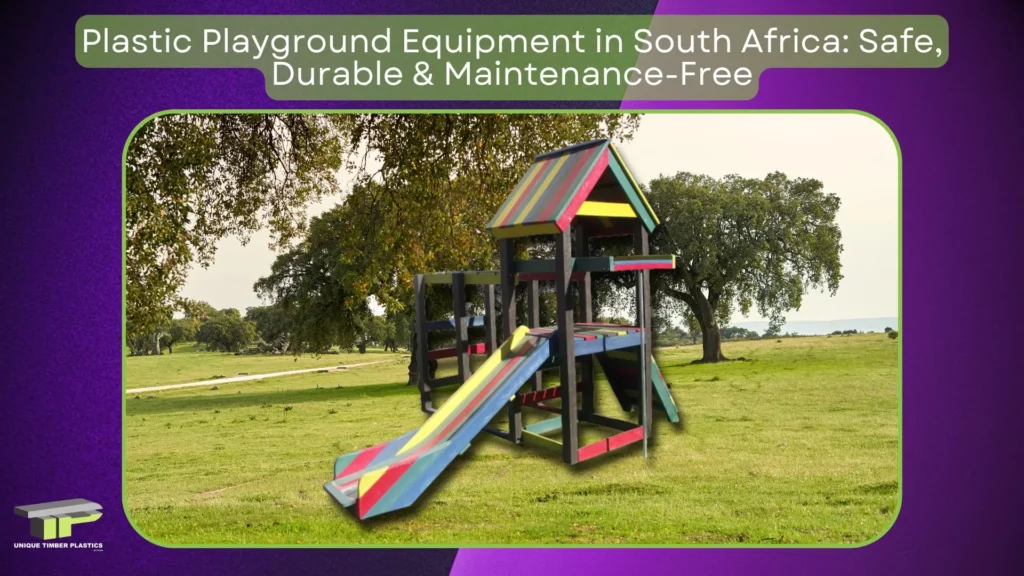
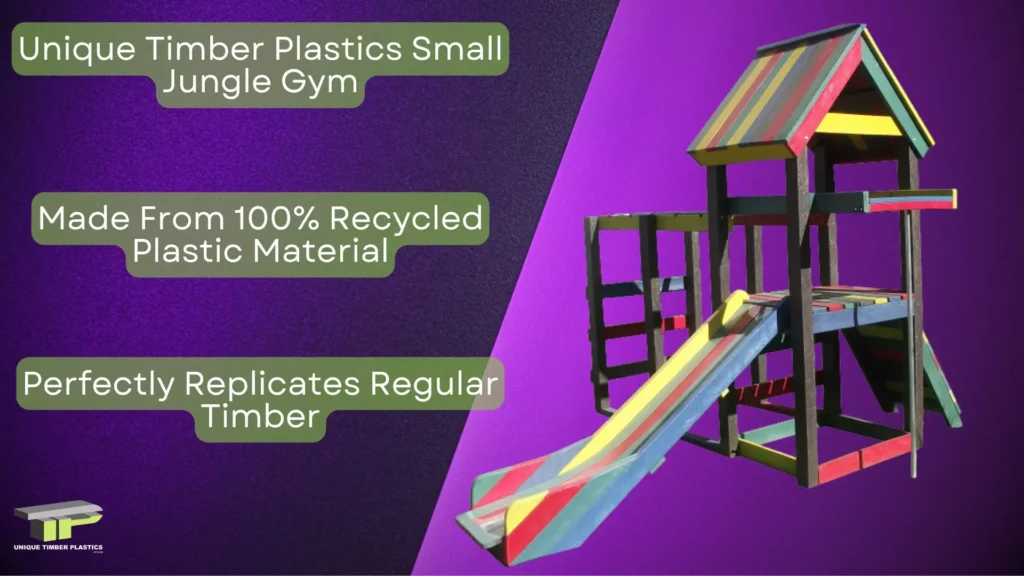
At Unique Timber Plastics, we provide two options for fully built jungle gyms made from 100% recycled plastic:
- Mini Jungle Gym: A smaller, but excellent piece of plastic playground equipment. Ensure the advantages of both fun and safety for years to come. Best suited for back gardens, nursery schools, or small parks.
- Jungle Gym: The real deal when it comes to ensuring that children have a large space for playing and having fun, while still creating a focus on safety and longevity. Best suited for primary schools and large parks, both municipal and estate.
View our selection of Jungle Gyms made from 100% recycled plastics. Built to replicated timber with the added value of safety & zero-maintenance
Where Plastic Playground Equipment is Best Suited in South Africa?
- Schools and educational facilities: Both government and private schools are among our primary buyers. The safety, hygiene, and durability advantages, while still creating a fun and welcoming environment for children, are directly relevant to school environments.
- Residential estates and gated communities: Communal play areas are a significant amenity in large residential estates. Recycled plastic equipment reduces maintenance costs and hazard liabilities for estate management.
- Game lodges and eco-tourism properties: Family-friendly game lodges benefit greatly from playground equipment compatible with their environmental values. Recycled plastic aligns with sustainability commitments as no chemical treatments are required.
- Municipalities and local government: Municipal parks benefit from the vandal resistance, low maintenance requirements, and long structural life that recycled plastic equipment bring to the table.
- Childcare centres and crèches: Smaller play structures are best suited for private childcare facilities, where hygiene and safety standards need to be particularly stringent.
What to Ask Before You Buy
Before committing to any playground equipment purchase, the following checklist helps ensure the product specifications meet your specific requirements based on what you are looking for in plastic playground equipment:
- Is the equipment manufactured from 100% recycled HDPE, LDPE, and PP, or is it a blend of virgin (basic timber/metal) and recycled material? (Recycled content level affects both the environmental claim and the overall performance of the equipment.)
- Is the equipment UV-stabilised throughout, or is UV protection a simple surface coating? (Integrated stabilisers are preferable for longevity predictions.)
- What are the structural pole and plank dimensions, and have they been designed for the desired age group and average height requirements?
- Can the supplier provide references or site photos of installed equipment for comparable scaling?
- Is the equipment compliant with the necessary South African safety standards for playground equipment (SANS 1718)?
- What are the ground-level safety surfacing requirements for the intended configuration that buyers need to be aware of?
- What is the lead time for manufacturing and delivery to your desired location?
- Is custom sizing and configuration available for spaces that have specific constraints?
FAQs
Is Unique Timber Plastics’ recycled plastic playground equipment SANS compliant?
SANS 1718 is the South African standard governing the safety of playground equipment, covering structural requirements, surfacing, use zones, and required equipment specifications. All of our equipment is designed and manufactured to meet the regulatory baseline for South African schools and public parks. Unique Timber Plastics does work with SANS, however we do not supply certifications or documentation on it. Clients will sign off on products and then use them at their own risk.
How long do our plastic playground equipment sets last?
Our quality recycled HDPE playground equipment has an expected structural lifespan of 60 years or more. This compares to the short 10–20 years for treated timber (in typical South African outdoor conditions) and 15–25 years for painted mild steel before rust damage typically reaches the point of requiring replacement. The practical implication for schools and municipalities is that plastic equipment purchased today will not require structural replacement during the active careers of current staff.
Is our plastic playground equipment safe for children?
Recycled plastic playground equipment eliminates several of the most common material-related hazards in playground environments that directly impact children: splinters, rust, and sharp edges from surface deterioration. It does not introduce chemical hazards involved with timber and metal maintenance, as the HDPE material is the same polymer used in food containers and is chemically inert. It is important to note that age-appropriate design, proper installation, adequate safety surfacing, and regular safety inspections remain essential regardless of the material choice.
Can plastic jungle gyms be installed on any surface?
Plastic playground structures can be easily installed on most common ground surfaces, provided the appropriate footings are implemented. Safety surfacing requirements (sand, rubber chip, synthetic turf, or impact-attenuating matting) are determined by the desired equipment height and the age-group specification, not by the equipment material.
What colours are available for plastic playground equipment?
We provide recycled plastic playground equipment in a range of standard colours that offer good UV and heat performance (earthy tones like brown, green, and grey), best suited for nature-themed installations, as well as brighter primary colour combinations for more traditional playground aesthetics. Colour runs through the full cross-section of the material, so surface scratches and minor damage do not expose a different-coloured underlying layer.
Putting Safety at the Forefront of Children’s Play Spaces
Safe playground equipment in South African schools, estates, and parks should not be defined by the lowest upfront cost, but by the full picture of structural safety, maintenance reliability, suitability for the local climate and use context, and above all else, childcare. On all four counts, recycled plastic playground equipment consistently outperforms its traditional alternatives.
For buyers evaluating plastic playground equipment in South Africa, Unique Timber Plastics (uniquetimberplastics.co.za) manufactures a comprehensive range of recycled plastic playground structures, jungle gyms, outdoor benches, and picnic furniture made from 100% post-consumer HDPE, LDPE, and PP. Based in Johannesburg and Cape Town and supplying nationally, we work with schools, estates, game lodges, municipalities, and commercial developers alike. The range is designed for South African conditions, built to last, and requires no maintenance over its working life.
Johannesburg branch: 011 626 2487/ 078 152 3605 | enquiries@timberplastics.co.za
Cape Town branch: 079 525 0361 | capetownsales@timberplastics.co.za